The Forgotten Douglas Type � The DC-5
The DC-5 is the often-forgotten member of the Douglas family. It was designed as a high-wing passenger transport, carrying 16-22 passengers & its prototype NX21701 first flew on 20/2/39.
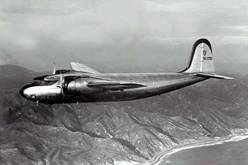
Although similar in size to the DC-3, it had the advantage of having a tricycle undercarriage, which allowed for easier loading. Only 5 commercial DC-5s (4 originally for British Airways, but later to K.L.M. & the prototype, which, oddly enough, went to William E. Boeing, as a VIP aircraft) & 7 military R3Ds (3 for the U.S. Navy & 4 for the U.S. Marine Corps) were built; partly because of the start of World War II.
British Airways Ltd., (the early one - not the current airline), which later became part of B.O.A.C., ordered nine DC-5s on 30/8/39, mainly for use on their London-Berlin route. However, the order was cancelled, soon after the start of World War II, on instructions from the British Air Ministry. Four of the aircraft went to KLM Pennsylvania-Central Airways ordered six & S.C.A.D.T.A. of Colombia ordered two, during 1939. But these orders were also cancelled.
None of the four DC-5s ordered by KLM, for their intra-European services, was ever operated by KLM itself, as the Netherlands were invaded in May 1940. Two were sent, in May 1940, initially to their West Indies Division, based at Cura�ao, as PJ-AIW & PJ-AIZ. The other 2 went, in 1941, to Java, to the Netherlands East Indies (now Indonesia)-based KNILM, as PK-ADA & -ADB. PJ-AIW & PJ-AIZ were transferred to Java in May 1941 & became PK-ADC & PK-ADD. PK-ADA was damaged & captured by the Japanese (and later taken to Japan). However, PK-ADB, ADC & ADD managed to escape to Darwin, in February 1942, shortly before the fall of Java and, with other ex-KN.I.L.M. aircraft, were 'acquired' by the U.S. Army Air Corps, in Australia. They were given civil 'call-signs' VHCXA (PK-ADB), VHCXB (PK-ADC) & VHCXC (PK-ADD) & allocated to what was called the Allied Directorate of Air Transport (ADAT), which undertook many transport duties for the U.S. & Australian forces in Australia & the South-West Pacific. All 3 were flew, at least occasionally by A.N.A. Captains, with RAAF Co-Pilots. VHCXA was badly damaged at Parafield, S.A. in 1942 & its remains were sent to Archerfield, Qld, for use as spares. Both VHCXB & VHCXC were allocated to the 21st Squadron 374th Troop Carrying Group. VHCXB was allocated for use by A.N.A., under charter from the ADAT, but was badly damaged, in Queensland, before entering A.N.A. service.
The A.N.A. DC-5 - VHCXC
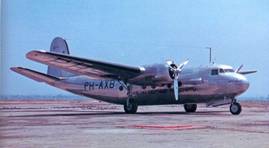
Ordered by British Airways Ltd., 30/8/39, as part of an order for 9, mainly for use on their London-Berlin route, with a planned delivery date to Floyd Bennett Field, New York, for shipment to the UK, February, 1940. Registration G-AFYK was allocated 30/8/39, but not taken up. Their order for DC-5s was cancelled, on the instructions of the British Air Ministry, after the outbreak of war. It was struck-off the U.K. Civil Register 14/9/39. Production positions for 4 aircraft of the order was transferred to KLM. It was ordered by KLM on 13/1/39, as DC-5-511 PH-AXB 'Bergeend' (Sheld-duck), later 'Boschduif' (Wood Duck) (photographs also show the (hybrid?) name �Boscheed�) (22 passengers), for $US102900.
However, it was delivered in May 1940 to KLM West Indisch Bedrijf (West Indies Division), at Cura�ao�s Hato Airport, repainted as PJ-AIZ 'Zonvogel' (Hummingbird/Sunbird). It was shipped in June 1941, via Miami & Santa Monica, to KNILM, Batavia, to become PK-ADD. It entered KNILM service 29/9/41 & escaped Bandoeng-Darwin overnight 1-2/3/42, just ahead of the Japanese. It is believed then flown to Mascot 4/3/42, for Customs clearance etc.
Although it operated for the USAAF from 28/3/42, it was officially delivered to USAAF at Archerfield, Qld., 15/5/42 & allocated call-sign VHCXC approximately 18/5/42. To the 21st TS, Amberley, Qld. 5/42, with the 2 other ex-KNILM DC-5s VHCXA & VHCXB. It may have also been known under serial 41-426. It was operated extensively; mainly carrying general cargo on the Australian east-coast & into New Guinea. The A.D.A.T. made arrangements with A.N.A. to maintain & operate VHCXC, plus C-56Bs VHCAF & VHCAJ & DC-3 VHCXD, in late-1942 & it was at Archerfield by 16/12/42. It was test-flown at Archerfield 25/12/42 (Capt. P.T. L. Taylor). Special Certificate of Airworthiness X5 was issued 25/12/42, for call-sign VHCXC - 2 crew/23 passengers - Wright G1820-G102A engines.
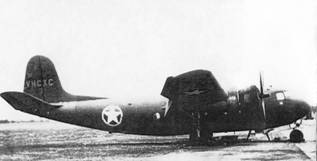
It was formally handed-over to A.N.A. at Archerfield, Qld., 26/12/42, for operations under contract to the A.D.A.T. & began operating the same day. It was based at Archerfield, in camouflage with VHCXC on tail & the U.S. star insignia. The starboard nacelle, starboard outer wing, flaps & ailerons were damaged at Archerfield, Qld, in a fire, 19/5/43, when thinners caught fire, while removing its camouflage.
|
In full camouflage, with correct VHCXC call-sign. |
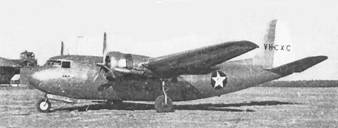
After removal of camouflage, with incorrect VH-CXC call-sign. |
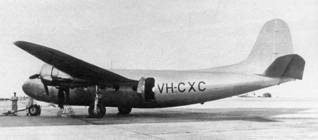
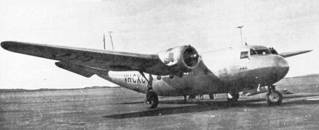
Parts of VHCXA were used in the rebuild. It returned to domestic service 14/7/43, now in an all-metal color scheme, but, initially, still with the USAAF stars on the rear fuselage. Its CoA was renewed 14/7/43, with the proviso that the aircraft could not be used outside Australia. It flew Archerfield-Mascot-Essendon 31/7/43.
It was withdrawn from service 30/4/44 & officially �returned� to the USAAF, but was retained & stored at Essendon by A.N.A. A D.C.A. inspection took place 13/5/44, with a view to obtaining civil registration.
It was under conversion for civil use 17/5/44, with bench seating (initially without seat belts), for Melbourne-Tasmania service, under lease, pending finalisation of a purchase arrangement. It operated to Tasmania, with registration VH-CXC (with an invalid hyphen). It was officially 'returned' to the USAAF 10/6/44, allocated serial 44-83232, as a C-110-DE, by the USAAF 14/6/44, as a book-keeping exercise, but never carried that marking. It remained leased to A.N.A. & underwent a 3-month refit 10/44. It was damaged in an accident at Essendon 12/9/44; details unknown. It was offered for sale by the USAAF 11/44 (18000-20000 hours - 22 passengers). Its CoA was renewed 25/1/45, 3 crew/22 passengers (1 report suggests 21). It was converted to new seating (16 seats) 15/7/45, after complaints to the D.C.A. It was sold to Australian National Airways 12/45, reportedly for �5000.
|
|
|

 It
was registered VH-ARD to A.N.A. 24/5/46 (CoR 968), but continued, for
unknown reasons, to be operated as VHCXC. Its last A.N.A. service, still as
VH-CXC, was 19/7/46, from Laverton to Parafield (Capt. Vern Polley). It was
then grounded, as its CofA lapsed on that date. A.N.A. advised the D.C.A.
that they did not intend to renew its CofA & it was ferried back to Essendon
by 9/8/46 & stored, still marked as 'VH-CXC�.
It
was registered VH-ARD to A.N.A. 24/5/46 (CoR 968), but continued, for
unknown reasons, to be operated as VHCXC. Its last A.N.A. service, still as
VH-CXC, was 19/7/46, from Laverton to Parafield (Capt. Vern Polley). It was
then grounded, as its CofA lapsed on that date. A.N.A. advised the D.C.A.
that they did not intend to renew its CofA & it was ferried back to Essendon
by 9/8/46 & stored, still marked as 'VH-CXC�.
It was not painted as VH-ARD until after its sale 2/1/48. It is believed that the auto-pilot was no longer fitted by the end of its service life; although details of its removal are not known.
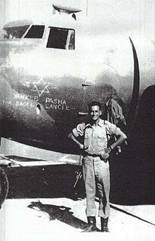
It was parked at Essendon Airport for about two years, awaiting a buyer. It was sold to Gregory Raymond Broad & G.W. Hanlon, Sydney, 2/1/48 & not repainted as VH-ARD until after the sale. It was to be used for Bass Strait services, but this was disallowed. It was illegally flown Essendon-Sydney 2/1/48, for overhaul & crew training. Board & Hanlon applied for registration in their name 5/1/48. It was damaged on take-off from Schofields, NSW, 29/1/48 when the undercarriage retracted too early, during a training flight. Its CoA was renewed 25/2/48. Registered to G.R. Board & G.W. Hanlon t/a New Holland Airways 27/4/48 & named 'Bali Clipper'. It operated at least one migrant charter to/from Rome & departed Darwin for Rome, for immigrants, 10/5/48. VH-ARD was struck off the Australian Register 10/5/48. It was flown illegally Roma (Sicily?)-Israel 28/5/48. It was taken-on-charge by the Israeli Air Force (Chel Ha�avir) 5/6/48, still in full N.H.A. markings & was delivered to Haifa Airport within days. A 2-tone camouflage was applied & the aircraft was given serial 1501. Named both 'Yankee Pasha' & 'Bagel Lancer' on the forward, port side. Reportedly based at the Ramat David Air Base from 6/48 & flown during the June 1948 Arab-Israeli War, with N� 103 Sqn. as a transport, flying troops & supplies to the Negev Desert. It is also reported to have flown �bombing� missions (with a hole cut in its lower fuselage). One report suggests that it was grounded 10/48, after a heavy landing at the Ramat David Air Base & lack of spares for a repair. Another report advises that it was grounded early-1949, due to lack of spare parts. It was the World's last-remaining DC-5. To the Israeli Defence Forces (Chel Ha�avir) Haifa Technological Institute, near Haifa AFB, 5/49 & used for instructional purposes. It was later parked at Tel Aviv Airport & gradually deteriorated. It was reportedly broken-up at Tel Aviv in 1955, although other reports suggest that it may have survived until 11/62 �still basically complete - lying in center of airport�, or even 1974.